 |
 |
|
|
 |
|
|
Tienda Online
|
|
|
|
Es seguro. Es Kalysis
|
|
|
|
Kalysis Lectores Tarjetas Inteligentes
|
|
|
|
Idioma
|
  · Últimos 100 publicados · Últimos 100 publicados
· Archivo de Artículos
 Tendrá solo UNA Tendrá solo UNA
Sabía que...
... KALYSIS es portada del Nilson Report?

Issue 814, July 2004
... la patente 2.186.534 de Kalysis es la base de la aplicación del DNI Digital o de la firma electrónica en tarjeta inteligente?
 ... el "token USB" es un invento español patentado presentado publicamente en Bruselas? ... el "token USB" es un invento español patentado presentado publicamente en Bruselas?
...Los beneficios de pagos móviles crecerán drásticamente a USD20,000 millones en todo el mundo, de acuerdo con un nuevo informe estratégico de ARC Group. Esta cifra representa un crecimiento anual del 100%, y se deriva principalmente de nuevos tipos de transacción como prepago desde cajeros automáticos y otros innovadores ATMs. |
|
|
Empleo en Kalysis GRUPO
|
|
|
|
Tiendas Online & Pago Electrónico
|
|
|
|
Kalysis Community
|
|
|
|
Tarjetas Inteligentes Estadísticas
|
|
|
|
Kalysis GRUPO
|

 KALYSIS Iberia, SL KALYSIS Iberia, SL
Plaza de Uncibay 3
Primera Planta
29008 Málaga
ESPAÑA
952 60 81 93
686 500 726
CENTRO DE INVESTIGACIÓN
BIC Euronova - Centro Europeo de Empresas e Innovación (CEEI)
Parque Tecnológico de Andalucía (PTA)
Málaga, ES 29590
ESPAÑA
INTERNACIONAL Voz
+34 952 608193
ANID - National Association of Researchers in Educational Methodology
Camino de las Aguas, 48
37003 Salamanca
España
 KALYSIS, SA de CV KALYSIS, SA de CV
:: General Payment Services de México, SA de CV
Camino al Desierto de Los Leones Número 35
Colonia San Ángel Inn
01000 México, Distrito Federal

KALYSIS Central America
USA Office
9800 Southwest 62nd St
Miami, Florida 33173
USA
116 Northeast 3rd Avenue
Miami, Florida 33132
USA
+1 260 KALY-202
 KALYSIS Nicaragua, SA KALYSIS Nicaragua, SA
Edificio Grupo Lacayo
Km 5½ Carretera Norte Managua
NICARAGUA

KALYSIS Argentina
Buenos Aires
ARGENTINA

AVICARD Identificación
Avda. Gestido, M-26, S-17, Sangrila
Canelones
URUGUAY

KALYSIS Chile
Obispo Orrego, 42. Ñuñoa
Santiago de Chile
CHILE

KALYSIS Colombia SA
CRA 46 No 56-63
OFIC. 109
Edificio Argental
Medellín
COLOMBIA
INTERNACIONAL Voz
+34 952 608193

Distribuidores EMEA
Austria, Alemania, Suiza, Dinamarca, Suecia, Noruega, Finlandia, Polonia, República Checa, Eslovaquia, Hungría, Eslovenia, Croacia, Latvia, Estonia y LituaniaRelaciones con la prensa y medios de comunicación
Iraís Quintana:

Sindicar Artículos de Kalysis Community
Tarjetas Inteligentes  |
|
|
|
Tarjetas Inteligentes - About Smart Cards
|
 |
Kalysis es un player innovador en tecnología de tarjetas inteligentes. Las afirmaciones acerca de las tarjetas inteligentes en este documento 'Tecnology Info' podría no ser de aplicación para la tecnología patentada de Kalysis: meramente reflejan el 'estado-del-arte' actual en el mercado.
Kalysis is an innovating player in smart card tecnology. The statements about smart cards in this document 'Tecnology Info' could not apply to Kalysis' patented tecnology: merely reflects the state-of-the-Art available at the present in the marketplace
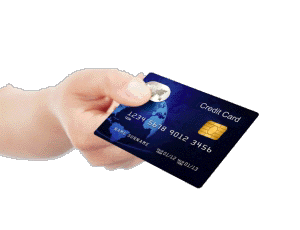
A smart card – a type of chip card – is a plastic card embedded with a computer chip that stores and transacts data between users. This data is associated with either value or information or both and is stored and processed within the card’s chip, either a memory or microprocessor. The card data is transacted via a reader that is part of a computing system. Smart card-enhanced systems are in use today throughout several key applications, including healthcare, banking, entertainment and transportation. To various degrees, all applications can benefit from the added features and security that smart cards provide. According to Dataquest, the worldwide smart card market will grow to 4.7 Billion units and $6.8 Billion by 2002.
The smart card, an intelligent token, is a credit card sized plastic card embedded with an integrated circuit chip. It provides not only memory capacity, but computational capability as well. The self-containment of smart card makes it resistant to attack as it does not need to depend upon potentially vulnerable external resources. Because of this characteristic, smart cards are often used in different applications which require strong security protection and authentication.
For examples, smart card can act as an identification card which is used to prove the identity of the card holder. It also can be a medical card which stores the medical history of a person. Furthermore, the smart card can be used as a credit/debit bank card which allows off-line transactions. All of these applications require sensitive data to be stored in the card, such as biometrics information of the card owner, personal medical history, and cryptographic keys for authentication, etc.
In the near future, the traditional magnetic strip card will be replaced and integrated together into a single card by using the multi-application smart card, which is known as an electronic purse or wallet in the smart card industry. The smart card is becoming more and more significant and will play an important role in our daily life. It will be used to carry a lot of sensitive and critical data about the consumers ever more than before when compared with the magnetic strip card. Therefore, there are many arguments and issues about whether or not the smart card is secure and safe enough to store that information. This has always been a source of controversy.
| | How are smart cards used?
Smart cards help businesses evolve and expand their products and services in a changing global marketplace. The scope of uses for a smart card has expanded each year to include applications in a variety of markets and disciplines. In recent years, the information age has introduced an array of security and privacy issues that have called for advanced smart card security applications.
| | Information Technology
Businesses, the government and healthcare organizations continue to move towards storing and releasing information via networks, Intranets, extranets and the Internet. These organizations are turning to smart cards to make this information readily available to those who need it, while at the same time protecting the privacy of individuals and keeping their informational assets safe from hacking and other unwanted intrusions. In this capacity, smart cards enable:
-Secure logon and authentication of users to PCs and networks
-Secure B2B and B2C e-commerce
-Storage of digital certificates, credentials and passwords
-Encryption of sensitive data
-Mobile Telecommunications
People using the Global System for Mobile communications (GSM) standard for mobile phones use smart card technology. The smart card is inserted or integrated into the mobile handset. The card stores personal subscriber information and preferences that can be PIN code protected and transported from phone to phone. The smart cards enable:
-Secure subscriber authentication
-Roaming across networks
-Secure mobile value added services
Wireless providers benefit from reduced fraud thanks to the security offered by smart cards. With the advent of mobile services such as mobile commerce, web browsing, and information services, wireless providers rely on smart cards to act as the security mechanism to protect those services. As a result, smart cards are beginning to move beyond GSM to secure mobile services for other wireless standards as well.
| | Commercial Applications
Smart cards also provide benefits for a host of commercial applications in both B2B and B2C environments. The smart card’s portability and ability to be updated make it a technology well suited for connecting the virtual and physical worlds, as well as multi-partner card programs. The cards store information, money, and/or applications that can be used for:
-Banking/payment
-Loyalty and promotions
-Access control
-Stored value
-Identification
-Ticketing
-Parking and toll collection
Multiple applications can be stored on the card, enabling partnering on card programs and providing benefit added convenience to the card readers costs.
| | |
|
|
|
|
|
|
Kalysis GRUPO © 2001-2021 Licensed Materials - Program Property of Kalysis. All Rights Reserved
Licensed under one or more Spain Patents Nº 2,186,534 assigned to Kalysis Iberia, SL. MEI® is a trademark of Kalysis GRUPO
All trademarks are the property of their respective companies. Technical data subject to change without notice

El Greco, 17. 29749 Málaga - Andalucía - España - EU ☎ (+34) 952 60.81.93 ☎ (+34) 952 22.79.60 ☎ (+34) 686-500-726
Inscrita en el Registro Mercantil nº 5 de Málaga. Tomo 3.322, Libro 2.234, Folio 45, Hoja MA-63694. Sociedad Limitada C.I.F. ES B92451996 Kalysis es un Operador Intracomunitario registrado en el V.I.E.S.
© 2001-2021 Kalysis Iberia, SL
|
|

 ☎ +34 952 60 81 93 | WhatsApp
  +34 686 500 726
 Business Intelligence







 Escríbenos.


 Tarjetas Inteligentes en Europa